Monday, February 25, 2019

Constructing American Identity

 American Identity: Exploring at the Montclair Museum
Jennifer Pappalardo

We are our own identity. It is our qualities, beliefs, personalities and looks and it can change almost any day based from our daily life experiences. It is also all a huge construct in America. Identity in America today has issued into people classifying each othercreating destructive impacts to our own self-image, self-esteem, and individuality. This is called social cognition, Judith Howard put it as "We categorize information about people, objects, and situations before we engage memory or inferential processes." A lot of this has to do with race, gender, class, ethnicity, sexuality, age, etc. Life has been established to put labels on people and into certain boxes of "you have to be like this" and "you can't be this". "Boys can't wear makeup".  "Natural hair isn't professional". "You're poor because you're lazy". "Wrinkles aren't sexy". Labels don't matter.

Constructing people into these boxes makes those who are mostly white, male, and wealthy superior in society. It encages these people from obtaining any power weighing down almost anyone who doesn't "fit" what is acceptable. Gives the people who are acceptable in society all the privilege and dominance. That one persons identity is now seeming to be less important than that persons. Like this person doesn't matter because they're gay, poor, colored or any other label that doesn't fit societies ways. And how is that fair to anyone growing up in this world? Everyone deserves a chance to be who they want to be on this earth. All anyone ever wants anyways is love, why is that so hard to do without the constructs of who you should be and identify as. 


Ben Jones


The first piece I'd like to discuss is Ben Jones. An amazing artist who had a lot of loud and worthy paintings and images in the museum. This specific one is one I had my eye on for a while it was one third from the Juxtapositions #11 (1941) piece. It goes into the stature of power over personal well being. If you look at the overall image it looks like a big cloud over a rainbow in the sky. On top is almost the god, power. Power rules over everything and is at the top. In the middle is almost a block between. Under it are the words spiritual, political, economic, sexual, mental & physical health, etc. and peace. Things that are important in life and matter to ones self. But the issue is who get's the power and who doesn't and what it is that is suffering people to being helpless. Too much power.


Jaune Qucik-to-See Smith


This next piece immediately caught my eye not only for its size but for its massive message. What is an American. And I myself had to pause and think. We are a huge melting pot. There's so much mixture and layers that I myself a normal boring American white girl questioned my own identity. Born on a land that slaughtered millions and took homes of those who've lived here for generations. What is an American? Created upon stacks of money and power that was taken from others and built railroads and sky scrapers and made up structures on ways humans have to live their lives. A made up materialistic culture based off from money, shopping, bingo, Disney channel etc. "Nagel (1996) characterize identity as a dialectic between internal identification and external ascription...identity [is] also as multilayered, with different identities activated at different times (e.g., for Native Americans—subtribal, tribal, supratribal-regional, or supratribal-national identities)" (Howard 375).


Dawoud Bey


 Smokey was my favorite in the exhibit, and same as the tour guide! There's something about this piece that makes you just feel vulnerable. His eyes says a lot about who his is and his struggles, as same with the hands. You can tell a lot about a person from their hands. And in this photograph his eyes and his hands are the only thing in focus. Bey the artist in this piece is exposing the reality of social problematics in society that categorizes and stereotype people. One can look at it as a tough rebellious black man as many do to those in real life, or you can just view it as a man sitting in the park. The point is for people to open their eyes and view individuals as nothing judgemental and just as a person. The artist wants to challenge the viewer and does it very well. This photograph is just beautiful from his fashion to his expression to the focus of the shot to the message of the art, everything just works.


Nan Goldin


This is a look. 
I just love her fierceness and
 her giving no fucks face. 
This photograph is very powerful and 
especially the date it was taken in too! 1953 was not a popular time for drag queens and was not accepted by many. And what I love about this photo is the person in the background almost looks disgusted with how Misty looks and she just doesn't care. She knows who she is and her identity. There's so much power in the photo that you can just feel it. Her confidence is so radiant.  Today drag queens are so popular and more acceptable now that you even appreciate this photo more. You know that it must've took her a lot to come out in front of others and dressed as a woman. "People develop and change over of their life spans, and thus that sexual identity may be fluid at some points, more crystallized at others (D'Augelli 1994)" (Howard).There's nothing wrong with this and it's completely normal to change how Back then you had to fight harder to be you. Today we sadly still have that challenge, but it's woman like Misty that we have to thank for standing up for her freedom and speak out against those who don't approve because it's not normal in society.


Larry Frank


Last piece I'm going to talk about is this gorgeous work by Larry Frank. There's many layers to theirs photograph which I love. You have her in the front and her in the painting in many positions in the back. The lighting, the tone, the message it's so beautiful and real. This is how is can feel as an individual who feels bombarded from society. Someone how is down and feels hopeless. Frank in this piece is "deeply pushing into the matter of what it means to be alive." Well what does it mean? It's about being yourself and being whom you truly are. Not staying stuck inside oneself and going down into that deep pit of darkness. Life is about human companionship, finding love and loving one another. Today in the world we've just become so disconnected and unaccepting of each other. It's time to find that love again from within and express it without so that we all can be as one and help each other out.


Sunday, February 24, 2019

So I went to the Museum, and it was Fun!

Julio Sabangan
Imagery, Identity, and Culture
2/22/19
Museum Trip

I am the type of person who drifts off and finds themselves wondering around aimlessly observing, discovering, admiring, and learning on my own. Although I attended with people in the class, I found myself peeling away from the groups and advancing to the other exhibits in the museum. However, as I travelled lonesome, I began to become immerse into the artwork surrounding me. I understood a lot of the artworks that people were making. As Judith Howard states from Social Psychology of Identities, “People behave toward objects on the basis not of their concrete properties, but of the meanings these objects have for them.” That itself drew me towards these certain pieces of art.


Blue Carts & Barbed Wired, 2018 Woolpunk (b. 1971)

At first when I looked at this, I thought to myself, “What a way to exemplify the fabrication over the remains of industrialism. —Literally…” That is basically what Woolpunk did. This photo was taken from Jersey City. An older city that has seen better days, is full of places like this; abandoned and dilapidated. In the description of this pieced it mentions the irony of abandoned lots like such being bought by the bidders and these lots have billboard signs above them stating, “Jersey City Make It Yours.” Looks like Woolpunk is showing that change is coming and that she sees it using the fabric to cover the blanks spots.


______________________________________________________


This piece is interesting. This was displayed in the Scholastic Art & Writing Awards Hall on the bottom floor. This was created by Min This piece is interesting. This was displayed in the Scholastic Art & Writing Awards Hall on the bottom floor. This is called S/N and was created by Min Jeong Cho, grade 12, of Tenafly, High School.
This spoke out to me greatly. This is the division of South and North Korea. People are holding on to each other trying to stay unified. There are two hands in the painting that are trying to reach each other, however, the yellow line prevents that from happening. This is a really powerful piece. This shows so many emotions of being divided. 


______________________________________________________


Another painting from the Scholastic Art & Writing Awards Hall. This piece is called, Through My Eyes. It was created by Erica Chung, grade 10, homeschooled. Out of all the paints in this hallway, this has to be by far my favorite piece. This tells a story within itself. The piece being called Through My Eyes, makes you wonder what the artist sees. Having a camera  actually pop out at you indicates that the camera are her eyes. This might be around leap here, but I believe that this painting wants us to visualize ourselves since the camera popping out are her eyes. 


______________________________________________________


Through My Window, 2017 Wonju Seo (b. 1964)

Initially, seeing this piece for the first time, it was overwhelming. There were a lot of things going on all at once. The artist strongly depicted memories using a visual language. The different patterns and colors, I did eventually see this a one’s memory. The shadows casting behind the fabric make out as waves and the darker cloths make out the land and the yellow fabric separates the land and sea. The artist wholeheartedly shows the outside as something beautiful, yet from a memory they experienced from many years ago. The style that the artist used is very traditional twist their own modern twist of their memories. 


______________________________________________________


Bernabe Mendez (Spiderman) 2007, Ducle Pinzón (b. 1974)

The term, “Not All Heroes Wear Capes” is what I think of when I see this. I am a huge comic book nerd. I loved seeing this piece there. The meaning behind it impacted me a lot with this as well. The artist has a collection of photographs like such about immigrants doing important jobs that go unnoticed. In a way, superheroes get credit as a superhero, however when they are in their alternative life they go unnoticed as well. Peter Parker as Peter Parker is just an average person, however when his mask comes on, he becomes Spiderman and everyone adores him. In a way, Pinzón is doing the exact same thing. Dressing people up in superhero costumes so we can appreciate them.


Saturday, February 23, 2019

Constructing American Identity Exhibit at the Montclair Museum

Brandon Ramdayal
Professors Caçoilo and Cherow-O’Leary
Imagery, Identity, and Culture 


“Constructing” an identity can mean a variety of things. One can construct an identity through experiencing events like having relationships, making new connections, or even through personality traits. Incorporating the class discussion into this “construction”, authors like Bell Hooks “construct” an identity through her experience with her father and the marbles as she’s told what she is told she could and could not do. What this experience ultimately did for Hooks was that it showed her an identity that was forced upon her father and other members of the patriarchy.
At the Montclair Museum of Art, there were a variety of exhibits with many pieces of art. The exhibit that is the point of focus is the “Construction of Identity in America,” which featured a lot of depictions that conveys identity in each artwork. The first artwork that struck me was Dulce Pinzón’s Bernabe Mendez (Spiderman). This piece introduces the viewer to a significantly different perspective and identity of a superhero, as this superhero was depicted to be a window washer. For some, window washing is a death-defying job, as you’re placed on harnesses that are sky high. The man in the spiderman suit is an immigrant who sends a part of his paycheck to his family back home. This artwork conveys identity by showing that a superhero isn’t just what you see in movies or comic books. To sum, what this artwork illustrates is the lengths that immigrants go to in order to survive in the United States.


The second artwork to catch my eye was Kehinde Wiley’s Matar Mbaye. This piece gives the viewer a look at a portrait of a youth from Senegal by the name of Matar Mbaye. Identity is constructed here by using elements of color and items from Senegal to construct a unique identity for Matar. What this creates for the piece is to incorporate colorful elements from African fabrics that come with a colonial past. Some would say that this piece is an autobiography of a self-portrait of how Wiley sees himself or how he identifies himself to be. All in all, this artwork displays an identity that illustrates one’s true colors.


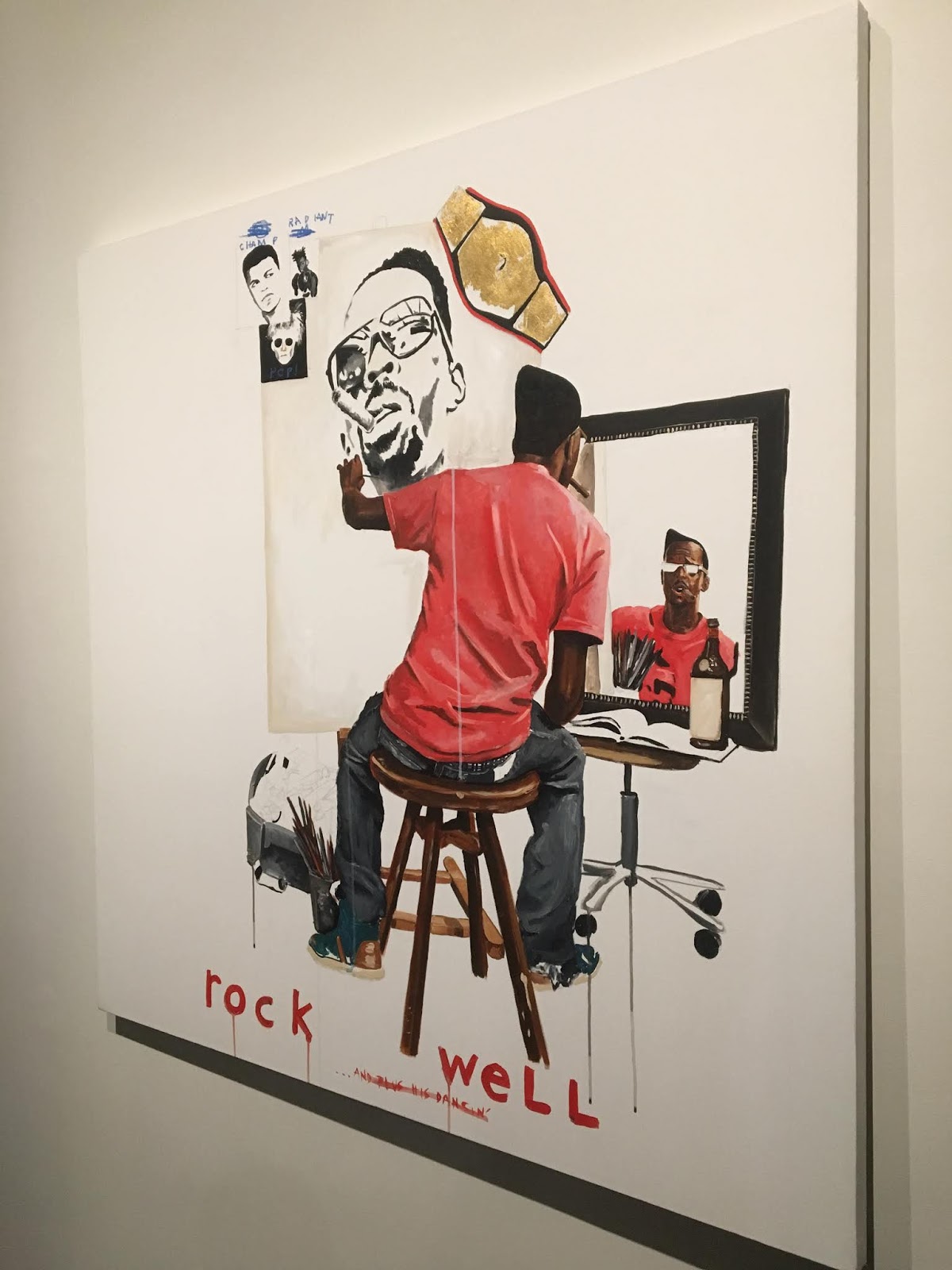
The third artwork that attracted me was Fahamu Pecou’s Rock.Well: Radiant, Pop, Champ. What was interesting in this artwork was that it was a reference to a previous artwork, Norman Rockwell’s Triple Self Portrait. The original piece featured Rockwell’s three most influential things in his life. Pecou’s take on Rockwell’s piece features his influences such as Michel Basquiat, Andy Warhol, and Muhammad Ali. This creates a self-portrait, but this one is unlike Matar Mbaye as this is more directly about the self instead of being illustrated through a muse. Overall, the identity that is constructed in this work is through Pecou’s influences and how he wants to portray himself to the public.


The fourth artwork that created a lot of appeal to me was Cindy Sherman’s Untitled #402. This artwork constructs an American identity in a variety of ways. The outfit that Sherman wears is star-spangled and features colors and patterns that are on the American flag. She also wears a hat that is similar to what suffragettes wore years ago. What made this artwork very interesting was that it was set right to a presidential portrait of George Washington. Even though the two are completely different people, some could say that their patriotism is similar. This goes to show how Sherman illustrates a cultural identity through the use of color and patterns.


Finally, the fifth piece of art displayed at the museum was Lorna Simpson’s Coiffure. There are many reasons why this piece can appeal to the public eye as well as construct an identity. One of those reasons is based on the fact that it is shot in black and white, which creates a perspective of how to view the artwork. Compared to the other works discussed, this is the only one that uses this color scheme. The piece gives the viewer three different perspectives to look at, a bird’s eye view, a view from behind, and a view from a mask. What these perspectives do is that they allow viewers to see things in different ways. The identity that this constructs is through the braiding of hair which can be seen from the first perspective and from the words below.

Friday, February 22, 2019

Constructing Identity

CONSTRUCTING IDENTITY IN AMERICA
MONTCLAIR ART MUSEUM EXHIBITION

CONSTRUCTION OF IDENTITY
The construction of identity is the forming or development of the many parts that can make up the whole. Identity can be very personal or applied to a group. The actual process of “construction” would insist that it happens over time. This can happen through different events and realizations of oneself. How one handles different situations, interests, family, cultural background, environment, values, social class and relationships can all contribute to or influence the formation of identity. Identity can change over the years and can be influenced by other people’s views of you.


CARRIE MAE WEEMS, Untitled from the Sea Island Series (Ebo Landing),​ 1992

CARRIE MAE WEEMS, Untitled from the Sea Island Series (Ebo Landing), 1992

Carrie Mae Weems has built a legacy of representations of the African American experience. In Weems', Untitled from the Sea Island Series (Ebo Landing),​ 1992,  she photographs Ebo Landing, a legendary place in the Gullah Region along the Georgia and South Carolina coast, where a group of Africans bravely walked into the sea and drowned themselves as a resistance to becoming slaves. The unique Cultural Identity of the Gullahs has been centered in this piece. The Gullahs are very different and have their own legacy almost and outside the Black American experience. They are one of the few Black regions that have held on to a large part of their African identity. Weems is showing the historic passing down of the legacy and tradition through the remembrance of this place. The scene in the photos looks calm and still almost like time has stopped there.

CARRIE MAE WEEMS, FRAMED BY MODERNISM

1996


"A picture is worth a thousand words." Carrie Mae Weems’ 1996 Framed by Modernism, consists of three photographs of a scene with with a white man and a Black woman both posing differently in each photo. The woman, who is nude is in the background and the man, who is fully clothed, is in the foreground, both seeming connected and yet disconnected. The physical expression of  while she seems to be relaxed yet holding back. The spacial differences don't just show in the physical distances but how society places women, often behind the man. She is in a more confined space, cramped in the corner, but making the best of her space, much like women's spaces, more particularly Black women and women of color's spaces. Where as the white man although seemingly uncomfortable and worried has all of the space out front. In Judith Howard's, Social Psychology of Identities, she dissects the concept of Identity and Space, “Some studies focus on literal space. Key questions consider “place identities,” that is, identities based on a sense of being at home. Key questions concern the effects of mobility on place affiliation and intersections between place identities and transitions in the life course."  


LORNA SIMPSON, COIFFURE,​ 1991
(images taken at museum  distorted by reflections, found this image online) 

LORNA SIMPSON, COIFFURE,​ 1991
page1image8155328

Lorna Simpson’s Coiffure, is displayed as three gelatin silver prints with 10 engraved plastic plaques below the . This artwork is documentation of some of the more delicate yet powerful parts of the culture. Hair is a huge cultural marker of people of African descent, particularly braided hairstyles. Black people’s hair throughout history has been commodified, politicized, penalized and accessorized. The winding braid in the middle reminds me of patterns in nature such as a sea shell or the lines in a tree trunk when cut it shows the history of the tree’s life time. 


CLEMENTINE HUNTER, MELROSE SUNDAY MORNING,​ 1965

Clementine Hunter’s, Melrose Sunday Morning, 1965 shows the concept of religious identity. This painting shows the cultural and religious history of many Black Americans mainly starting in the South. Hunter knew this experience for herself, since she spent most of her life on a plantation in Louisiana. The painting shows what I have also witnessed throughout my life when going to church. Members traditionally in their “Sunday Best” going to church. Religion is a huge cultural identifier for the Black Community, from the pretty hats to the colorful dresses. This artwork immediately made me feel nostalgia and as if I were looking at a freeze frame of timeless history. However even though it is listed as religious identity, according to Judith Howard’s writings it would also be considered intersectional identity because of race, gender and religion cross paths here.


DENNIS OPPENHEIM, IDENTITY STRETCH,​ 1970-75

Dennis Oppenheim’s Identity Stretch, is a one-panel photo documentation with photo reproduction and collage elements. He is well known for his Earthworks and Conceptual Art. It examines Identity and sense of place through a collage of different images that have similar. The fingerprints belong to both Dennis and his son and can be seen a marker of the personal or biological stamp of identity. In society we even use “someone putting their fingerprints on something literally and figuratively, as an “expression”. Applying this to Howard's statements, this choice of grouping these images of the fingerprints, aerial shot of terrain and seemingly perhaps in an abstracted physical manifestation of her sentiments. Oppenheim’s collage is perhaps showing our place in the world, it is intriguing that all the images share multiple line patterns. In Judith Howard’s, Social Psychology of Identities, she mentions, Space, both geographic and virtual, is another recent basis of identities, a direction that attests to the interdisciplinary character of recent research on identities.” Some studies focus on literal space; consider “place identities,” that is, identities based on a sense of being at home. Key questions consider “place identities,” that is, identities based on a sense of being at home. Key questions concern the effects of mobility on place affiliation and intersections between place identities and transitions in the life course."

Constructing Identity


Jahi Lendor
Colloquium in ACM
Re: Constructing American Identity


In Judith Howard’s Social Psychology of Identities abstract she almost immediately quotes 2 sources that resonate with me and the concept of identity. “Identity ... is a concept that neither imprisons (as does much in sociology) nor detaches (as does much in philosophy and psychology) persons from their social and symbolic universes, [so] it has over the years retained a generic force that few concepts in our field have.” And “[I]dentity is never a priori, nor a finished product; it is only ever the problematic process of access to an image of totality.” Based off of the stated quotes constructing an identity is exactly that, a construction. Constructing an identity is our own identity mixed in with the predetermined identity given to specific groups of people. Will live in a world where we believe we can be anything we want to be. But the truth is we grew up in world that told us who we are before we can get a driver’s license. Initial identities seem to steer towards stereotypes. One definition of identity is the qualities, beliefs, personality, looks and/or expressions that make a person or group. One definition for stereotype is a widely held but fixed and oversimplified image or idea of a particular type of person or thing. Both definitions have their distinct differences but have a simple similarity I believe. An idea of how a person should be. Particularly idea. I believe Identity is an idea we manifest on a daily basis for the outside world or anything outside of ourselves. Then we have our own identity that’s with us at every moment that everybody doesn’t see. Identity is a tool. 
In a Stanford University study by James D. Fearson he states “As we use it now, an “identity” refer to either (a) a social category, defined by membership rules and (alleged) characteristic attributes or expected behaviors, or (b) socially distinguishing features that a person takes a special pride in or views as unchangeable but socially consequential (or (a) and (b) at once). In the latter sense, “identity” is modern formulation of dignity, pride, or honor that implicitly links these to social categories.” Identity is whatever we need it to be in the current moment. With someone’s core values and morals staying pretty consistent and creating the steady and strong core identity, I believe our identity is fluid. We add and subtract when needed to our identity. Howard goes on to say “At the most basic level, the point is simply that people actively produce identity through their talk. Many studies (generally ethnographic) analyze identity work through everyday interaction. Identity talk is organized around two sets of norms, one concerning respect for situated identities and a commitment to basic moral precepts, and the second concerning ways in which people deal with failure to endorse these basic moral precepts, through denials of responsibility and other attributional tactics (Hunt et al 1994). Identity work is a micro-level performance of social (dis)order.”
The Constructing Identity in America exhibition at Montclair Museum which featured 90 paintings sculptures and works on paper encompassed a broad range of definitions of personal identity throughout American history and culture to quote the given text. This already is a very well stated piece of information that conveys how identity is portrayed in each of the works.  I painstakingly went over most of the work at around three times paying close attention to key moments in each piece trying to figure out each artist’s own sense and understanding of identity. What I noticed particularly was not every piece featured or highlighted a person. Some were mere objects, locations, words, or a collection of items that the artist believe to represent identity. This harkens back to Howard’s Reading again. Specifically, her thoughts on interactionism. “The basic premise of symbolic interaction is that people attach symbolic meaning to objects, behaviors, themselves, and other people, and they develop and transmit these meanings through interaction. People behave toward objects on the basis not of their concrete properties, but of the meanings these objects have for them. Because meanings develop through interaction, language plays a central part. Identities locate a person in social space by virtue of the relationships that these identities imply, and are, themselves, symbols whose meanings vary across actors and situations.”
            A couple pieces that captured my attention and drew me in and had distinct difference in identity. The first one being Alice Neel’s 1974 Isabel Bishop. Neel was known for painting her family, friends, artist friends, and colleagues in a unflinchingly honest way. Neel is at times brutally honest in portraits by creating clear emphasis and certain areas and leaving other areas bare or not as developed on the canvas. In Isabel Bishop, who was a painter-printmaker herself Neel keyed in on Bishop’s powerful arthritic hands and eyes. Those parts of the body are clear cut focal points in the painting. Neel’s honest portrayal of people tells me she believed that identity must be true to one’s self. You can’t hide. Your identity must be authentic and painstakingly honest.
Leonard Baskin’s 1974 Crazy Horse stopped me in my tracks. Baskin portrayed Lakota Sioux leader Crazy Horse. Baskin takes a simplistic but not simple approach but also still honest. A subtler and calculated touch. Each gesture, line, and stroke serves a purpose. For me the identity of Crazy Hoarse rest in his eyes and shadows. Baskin’s use of black captures a dignity and tragic tone. I feel the pain. Baskin shows Identity doesn’t have to be loud or overly expressive and outward. It can be introverted yet still be outwardly telling.
Wardell Milan’s 2008 One could still dream to devise an optimistic antidote against the defeatist and cynical claims of the Return to Order brings back up the idea of interactionism and connections to objects. Milan himself creates large, montage-style photographs that at first appear digitally edited, but are shot directly from tabletop dioramas that he assembles in the studio. In this particular piece Milan presents detritus left from an unknown disaster. The featured items seem to be leftover artifacts from a family. This piece speaks to the items that we have that play a role in our construction of identity. At times items come to represent us. Intimate family photos are repeatedly found in this piece this makes the work very personal but an unknown one.
Andrew Moore’s 2009 United Artists, Organ Screen, Detroit, MI sheds light on identity and sense of place. Moore’s work usually features photographs of detailing remnants of society in transition through the formal vocabularies of architectural and landscape photography and the narrative approaches of documentary photography and journalism. This piece spoke to me because even in deconstruction or decay there still is a story being told. The past, the present, and future. This piece leaves you fantasying what this theater use to look like in its former glory but then that quickly turns to despair when come back to the now. Location also plays a significant role in identity making. I can personally say my place of birth has molded my identity.
Kehinde Wiley’s 2007 Matar Mbaye(Study1) captures ethnic and cultural identity. Wiley paints his subject in a light is usually never seen. One of sensuality, dignity and gravity. This is a conscious decision to counter the absence of black bodies in museum spaces. The identity displayed is one of internal worth and regalness.